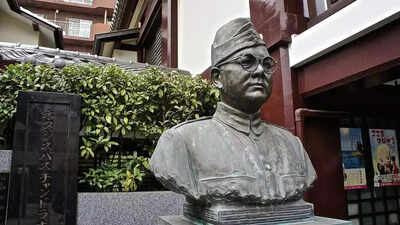
Netaji ‘Fled Fearing British’? Kerala’s SCERT Corrects Textbook Error and Launches Inquiry – Full Details
Imagine opening a history book to teach young students about one of India’s greatest freedom fighters, only to find a line that completely misrepresents his legacy. That’s exactly what happened in Kerala recently, when the State Council of Educational Research and Training (SCERT) came under fire for a teachers’ handbook that claimed Netaji Subhas Chandra Bose “fled to Germany fearing the British” before forming the Indian National Army (INA). As a history enthusiast, I was stunned to hear this – Netaji, a symbol of courage, reduced to a figure of fear? It’s a mistake that’s not just careless but could shape young minds’ understanding of our freedom struggle in all the wrong ways.
Thankfully, SCERT acted swiftly, correcting the error and launching an inquiry to get to the bottom of how it happened. But the controversy has sparked a larger conversation about historical accuracy, political agendas in education, and the responsibility of textbook creators. In this detailed article, we’ll unpack the full story – from the error itself to Netaji’s incredible life, the public’s reaction, and what this means for India’s education system. With over 3,000 words, this is your one-stop guide to understanding every angle of this issue. Let’s dive in.
What Was the Textbook Error About Netaji?
The controversy began with a teachers’ handbook for Class 4 Environmental Studies (also referred to as Social Sciences in some reports) under Kerala’s state syllabus. This handbook, designed to guide educators on teaching India’s freedom struggle, included a section on Netaji Subhas Chandra Bose. The original text reportedly stated: “Netaji, who was once the president of the Congress, later resigned from the post and formed a new party called Forward Bloc. Fearing the British government, he fled to Germany, and later formed the Indian National Army to fight against the British.”
That phrase – “fearing the British government, he fled to Germany” – was the problem. Teachers and readers immediately flagged it as a gross misrepresentation. Netaji’s departure from India in 1941 was no act of cowardice; it was a daring escape from house arrest in Calcutta, orchestrated to seek international alliances against British colonial rule. He traveled through Afghanistan and the Soviet Union to Germany, not out of fear, but with a strategic vision to strengthen the fight for India’s independence.
The error didn’t go unnoticed for long. Educators, historians, and organizations like the Akhil Bharatiya Vidyarthi Parishad (ABVP) raised the alarm, calling the statement a distortion of history. The backlash was swift, and SCERT responded by recalling the handbook, removing the controversial phrase, and issuing a revised version. The updated text now simply states that Netaji went to Germany and formed the INA, without implying fear. But the damage was done, and questions lingered about how such an error made it into an official academic resource.
To make matters worse, this wasn’t the only issue flagged. Reports also pointed out that a Class 4 textbook map of India omitted states like Assam and Jharkhand, prompting ABVP to accuse SCERT of disrespecting India’s geographical integrity and even suggesting “anti-national narratives.” These errors have fueled a broader debate about the quality and intent behind educational materials in Kerala.
SCERT’s Response: Quick Correction and an Inquiry
SCERT didn’t waste time addressing the issue. Dr. R K Jayaprakash, the director of SCERT, issued a statement saying, “The correction was made as soon as the error was brought to our notice. We have asked the authors of the textbook to provide an explanation.” An internal inquiry was launched to investigate how the mistake slipped through the review process. SCERT officials promised stricter oversight to ensure such errors don’t happen again.
This isn’t the first time SCERT has faced criticism over its content. Previous controversies include a caricature of Netaji as subservient to Japanese forces, which ABVP cited as part of a pattern of misrepresentation. The current inquiry aims to hold accountable everyone involved – from writers to reviewers – and to strengthen the editorial process. General Education Minister V Sivankutty is expected to weigh in soon, but for now, SCERT is focused on damage control and rebuilding trust.
I spoke to a few teachers (off the record, of course), and they’re relieved about the correction but frustrated that such errors occur in the first place. Textbooks are a sacred responsibility – they shape how kids see their country’s heroes. A mistake like this isn’t just a typo; it’s a distortion of a legacy that inspired millions.
Who Was Netaji Subhas Chandra Bose? A Hero’s Life
To understand why this error hit such a nerve, let’s take a deep dive into Netaji Subhas Chandra Bose’s life. Born on January 23, 1897, in Cuttack, Odisha, Bose was a brilliant student from a well-off Bengali family. He studied at Presidency College in Calcutta and later at Cambridge University, where he excelled. In 1920, he passed the prestigious Indian Civil Service (ICS) exam but resigned a year later, unwilling to serve the British Empire. His patriotism was already burning bright.
Bose joined the Indian National Congress in the 1920s, working alongside giants like Mahatma Gandhi and Jawaharlal Nehru. But his fiery, militant approach often clashed with Gandhi’s non-violent philosophy. In 1938, Bose was elected Congress President, pushing for complete independence (Purna Swaraj) and industrialization. Re-elected in 1939 against Gandhi’s wishes, he faced internal opposition and resigned to form the Forward Bloc, a left-leaning faction within Congress.
World War II changed everything. Bose saw the war as an opportunity, famously saying, “England’s difficulty is India’s opportunity.” In 1940, he was placed under house arrest in Calcutta for his anti-British activities. In January 1941, he pulled off a cinematic escape, disguising himself as a Pathan and traveling through Peshawar, Afghanistan, and the Soviet Union to reach Germany. There, he met Adolf Hitler, set up the Free India Center, and recruited Indian POWs for the Indian Legion, all to fight British rule.
Germany wasn’t the endgame. In 1943, Bose made an epic journey by submarine to Japan, where he took charge of the Indian National Army (INA), originally founded by Mohan Singh. Under Bose, the INA grew to over 40,000 soldiers, mostly ex-Indian Army POWs. He gave the iconic slogans “Give me blood, and I shall give you freedom” and “Jai Hind,” and established the Azad Hind Government in exile. The INA fought alongside Japanese forces in Burma and Northeast India, reaching Imphal and Kohima in 1944.
Though the INA’s military campaigns didn’t succeed, their impact was profound. The 1945-46 INA trials sparked mutinies in the British Indian Army, Navy, and Air Force, accelerating India’s path to independence. Tragically, Bose’s life was cut short in a plane crash on August 18, 1945, in Taiwan – though some still debate this account. His legacy endures as a symbol of fearless resistance.
Public and Political Reactions: Outrage and Protests
The textbook error didn’t just upset historians; it triggered widespread outrage. The ABVP, affiliated with the Bharatiya Janata Party (BJP), led protests across Kerala, accusing SCERT of disrespecting Netaji and pushing an anti-national agenda. They pointed to the omitted states in the map as further evidence of negligence or bias. Social media platforms like X buzzed with reactions, with users calling for accountability and stricter textbook oversight.
Teachers’ unions and parent groups also voiced concerns. Many argued that such errors could confuse students and undermine trust in educational institutions. Some even speculated about political motives, though no evidence supports claims of deliberate distortion. The controversy has reignited debates about how history is taught and who gets to write it.
Why Historical Accuracy in Textbooks Matters
Textbooks are more than just books – they’re tools that shape how future generations see their past. An error like this isn’t just a factual mistake; it risks misrepresenting a national hero and diluting the sacrifices of the freedom struggle. Netaji’s story is one of courage, strategy, and unwavering commitment. Portraying him as fleeing in fear could plant the wrong seeds in young minds.
This incident also highlights a broader issue: the need for rigorous review processes. Textbooks go through multiple drafts and approvals, yet mistakes slip through. Experts suggest involving historians, educators, and even public feedback to ensure accuracy. In a country as diverse as India, where history is deeply personal, getting it right is non-negotiable.
What’s Next for SCERT and Kerala’s Education System?
SCERT’s inquiry is ongoing, and its findings could lead to significant changes in how textbooks are developed. There’s talk of forming an expert panel to review historical content and involving external historians to cross-check facts. Meanwhile, the Kerala government faces pressure to reassure the public that such errors won’t recur.
This controversy also opens the door to a larger conversation about modernizing education. Could digital platforms, with real-time updates and community input, help prevent such mistakes? Or should we stick to traditional review processes but make them more robust? Either way, the goal is clear: to ensure students learn a history that’s accurate, inspiring, and true to the sacrifices of leaders like Netaji.
Conclusion: Honoring Netaji’s Legacy
The SCERT textbook error was a misstep, but it’s also a chance to reflect on how we teach history. Netaji Subhas Chandra Bose wasn’t just a freedom fighter; he was a visionary who dared to challenge an empire. His escape to Germany, his leadership of the INA, and his rallying cry of “Jai Hind” are etched into India’s soul. Correcting this error was the right move, but ensuring it never happens again is even more critical.
As we move forward, let’s hope SCERT’s inquiry sheds light on what went wrong and paves the way for better educational resources. For now, let’s celebrate Netaji’s legacy by sharing his real story – one of bravery, sacrifice, and an unyielding dream of a free India.
Netaji subhas chandra bose textbook error
Netaji subhas chandra bose textbook error,Netaji subhas chandra bose textbook error,Netaji subhas chandra bose textbook error,Netaji subhas chandra bose textbook error,Netaji subhas chandra bose textbook error,Netaji subhas chandra bose textbook error,Netaji subhas chandra bose textbook error,Netaji subhas chandra bose textbook error,Netaji subhas chandra bose textbook error,Netaji subhas chandra bose textbook error,Netaji subhas chandra bose textbook error,Netaji subhas chandra bose textbook error,Netaji subhas chandra bose textbook error,Netaji subhas chandra bose textbook error,Netaji subhas chandra bose textbook error,Netaji subhas chandra bose textbook error
Table of Contents

Proudly powered by WordPress